Yesterday during a visit to Knysna, the Premier of the Western Cape, Alan Winde, commented on the need to develop long-term water security plans after this particular crisis in Knysna has been averted.
He is right of course.
Just the day before the United Nations released this report, entitled GLOBAL WATER BANKRUPTCY — Living Beyond Our Hydrological Means in the Post-Crisis Era. The report starkly states that we have reached a point of "water bankruptcy" globally and that this is now "a persistent post-crisis condition of a human–water system in which long-term water use has exceeded renewable inflows and safe depletion limits, causing irreversible or effectively irreversible degradation such that previous levels of water supply and ecosystem functions cannot realistically be restored."
What does this mean for Knysna and indeed the Garden Route in general? This map from the report tells the whole story.
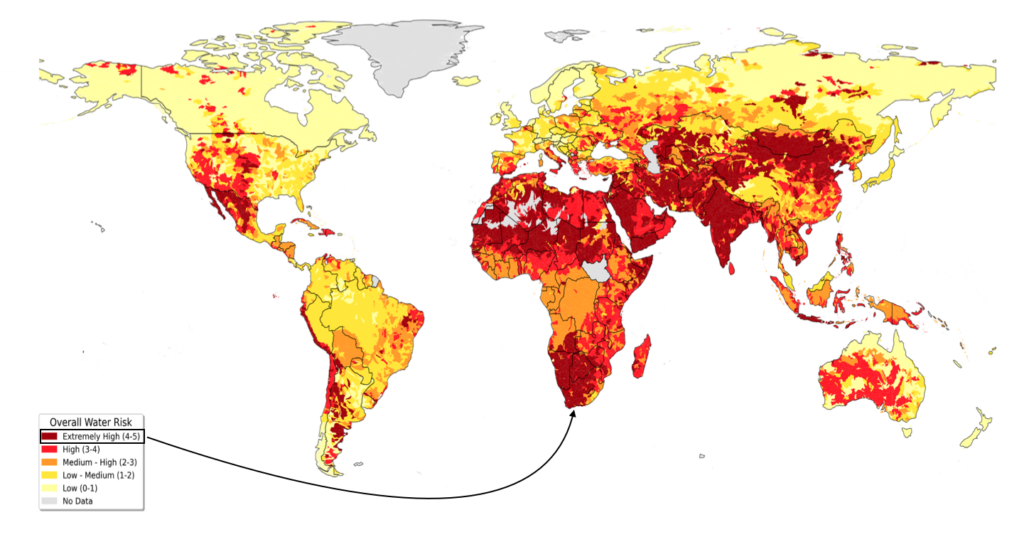
Yes you are reading that correctly, the overall water risk for this part of South Africa is rated as Extremely High. This means that planning for the future in Knysna and the Western Cape in general has to take this data very seriously.
From the report
The term “Day Zero” has been used to describe moments when municipal systems are on the verge of being unable to supply piped water to most residents, as seen in widely publicized emergencies in cities such as Cape Town, Chennai, São Paulo, Tehran, and others. In each case, headline-grabbing shortages were triggered by drought, but made possible by years of over-allocation, unchecked demand growth, and delayed investment in diversified water sources. Emergency measures—severe restrictions, tariff changes, rapid drilling of new wells, reliance on tanker supplies, and behavioral campaigns—helped some cities narrowly avoid a complete shutdown of taps. Yet in many of these places, the underlying aquifers, reservoirs and catchments remain degraded, and poorer neighborhoods continue to live with intermittent service, tanker dependence, and high water costs long after the media attention has moved on. [italics mine]
Sound familiar? Add to this aging infrastructure and bad maintenance practices and you have a recipe for disaster.
The report continues with this warning and one which Knysna in particular will have to take note of:
From a water management perspective, Day Zero must not be treated as a one-off crisis to be “survived”, but a symptom that urban systems are already operating beyond their hydrological carrying capacity. The fact that a formal shutdown of the network is narrowly averted does not mean the system has rebounded; it often means that hidden forms of rationing, informal coping mechanisms, and unequal access have become the new normal. Urban Day Zero events therefore sit on the same continuum as collapsing aquifers, drying rivers and failing rainfed agriculture: all are manifestations of human–water systems that in addition to reaching insolvency, can no longer return to their previous state and must be reorganized under permanently tighter constraints. [italics mine]
The report then goes on to provide five guiding principles on how to navigate a bankrupt water system and it is hoped these will guide decisions here going forward.
Here they are:
- Tell the truth about limits and losses: Denial and delayed acknowledgement of failure are among the most damaging responses to water bankruptcy. When governments, utilities, city managers, or basin authorities insist that conditions are temporary, or promise a return to past levels of supply that are no longer hydrologically feasible, they lock societies into maladaptive investments and deepen over-extraction. Transparent communication about what has been lost, what cannot be restored, and what can still be saved is a precondition for any legitimate restructuring of claims.
- Prioritize prevention of further irreversible damage. Once components of water capital are degraded beyond recovery, the system’s options narrow. Bankruptcy management must therefore place non-reversible thresholds at the center of planning: protecting remaining wetlands and aquifers, preventing further land subsidence and saltwater intrusion, safeguarding key species and ecosystems, and maintaining minimum cryospheric and soil functions where they still exist. These should not be treated as optional co-benefits; they must be adopted as high-priority objectives and prerequisites for any viable future.
- Align claims and expectations with degraded carrying capacity. In many human-water systems, the sum of legal rights, informal expectations, and development promises exceeds what the degraded system can supply. This claim–capacity mismatch and expectations-reality gap cannot be closed through marginal efficiency gains or new infrastructure alone. It requires structural reductions and reallocations in demand: revisiting water rights, revising crop mixes and land use patterns, reconsidering the size and location of cities and industries, and adjusting environmental flow commitments to what is ecologically essential and feasible. This rebalancing is politically sensitive, but unavoidable.
- Protect the vulnerable and share unavoidable losses fairly. Water bankruptcy tends to hit those with the least political and economic power the hardest: smallholder farmers, pastoralists, informal urban residents, rural populations, Indigenous communities, women, girls, and children, and downstream users. So water bankruptcy governance must explicitly integrate equity and justice, ensuring that the costs of adjustment are not simply shifted onto those least able to bear them. Compensation, social protection, livelihood diversification and legal safeguards are essential components of any credible restructuring.
- Build institutions for continuous adaptation, not one-off fixes. In a changing climate and degrading environmental and hydrological landscape, no allocation, infrastructure plan, or agreement can be permanently stable. Institutions must be capable of learning and adaptation, with monitoring systems that track stocks and trends, procedures that trigger adjustment when thresholds are approached, and governance arrangements that include affected communities in decision making. Water-bankrupt systems cannot be governed by static plans; they require iterative, adaptive, and reflexive management.
Let's hope we are up to this challenge!