The latest infrastructure updates from Knysna Municipality and the Western Cape Government are important, particularly for the water system. Pump station refurbishments, groundwater rehabilitation, improved transfer infrastructure and efforts to reduce losses through metering should all help the system operate more reliably.
Resilience in a water system
A resilient system is not one that never comes under pressure but it is one that can absorb shocks, continue functioning and recover before critical thresholds are crossed.
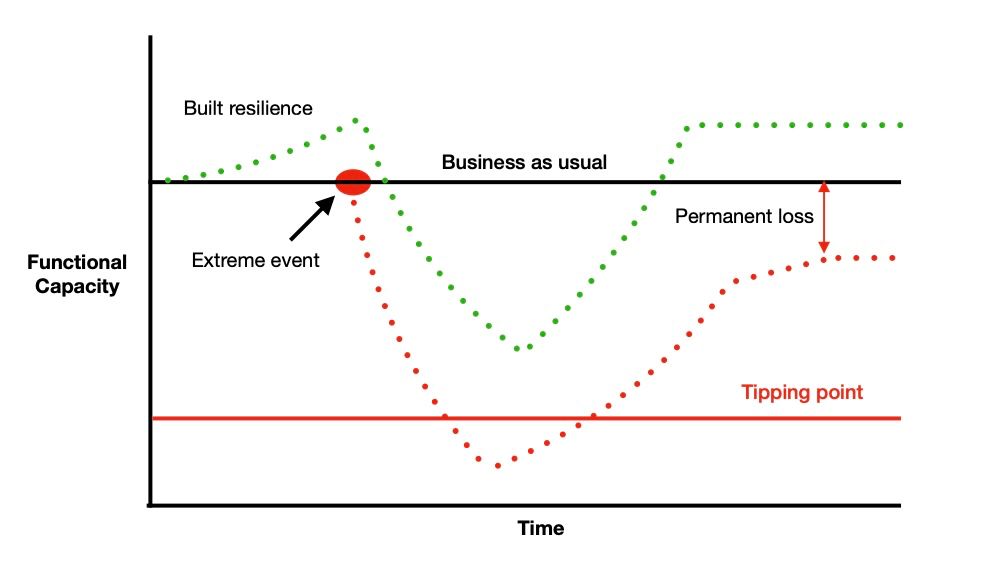
That is where the graphic above becomes useful.
The “business as usual” pathway illustrates what can happen when a system lacks sufficient resilience to absorb an extreme event. Once that tipping point is crossed, recovery becomes incomplete and the system settles into a lower long-term level of functionality resulting in permanent loss.
The “built resilience” pathway still experiences the same extreme event, but the system has enough flexibility and buffering capacity to recover without permanent loss of function.
This is increasingly relevant to Knysna
The municipality’s current interventions appear focused on exactly these resilience-building measures:
- improving pumping reliability
- strengthening transfer capacity
- diversifying supply through groundwater
- reducing non-revenue water losses
- improving operational flexibility within the network
None of these remove the town’s dependence on healthy river inflows and sustained rainfall. The Knysna system remains heavily reliant on surface water abstraction from the Knysna and Gouna rivers, supported by smaller augmentation sources and storage buffers like Akkerkloof.
But these upgrades will still make a major difference.
A more resilient system is better able to:
- capture water during high-flow periods (like the current one)
- reduce avoidable losses
- maintain supply during outages
- recover storage more effectively
- and continue operating through periods of stress without cascading failure
Recent data has clearly shown how the town has been operating within relatively narrow margins. Storage levels have continued declining while raw water input trends lower, and operational limitations at Charlesford appear to have reduced the system’s ability to fully capture available river flows during some periods.
This does indicate that the importance of built resilience is growing.
The current work underway should help widen the margin between normal operating pressure and a much more serious system failure scenario. In practical terms, the goal is not to eliminate drought risk entirely as that, in practice is not possible, but rather to improve the town’s ability to withstand difficult periods without crossing into long-term instability or permanent loss of functionality.
This is what resilience-building looks like in practice!