As is the custom before each COP a series of reports are released looking back on the previous year and looking forward based on commitments parties to the Paris Agreement make with their Nationally Determined Contributions.
Here is a collection of the major reports and their findings.
First up is the WMO's Greenhouse Gas Bulletin.
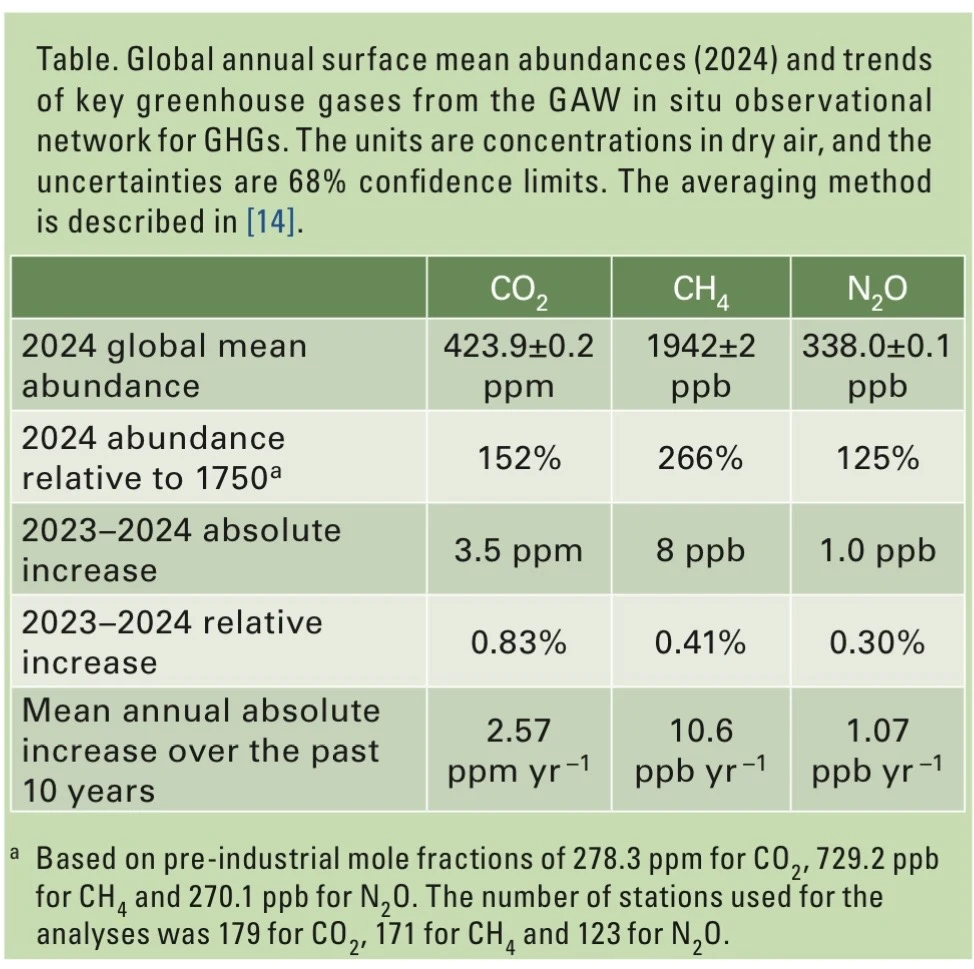
They say:
From 2023 to 2024, CO2 in the global surface atmosphere increased by 3.5 ppm, the largest one-year increase since modern measurements began in 1957. This increase was driven by continued fossil CO2 emissions, enhanced fire emissions and reduced terrestrial/ocean sinks in 2024, which could signal a climate feedback.
Why is this happening?
It's all pretty straightforward, as described in the Systems Change Lab State of Climate Action Report
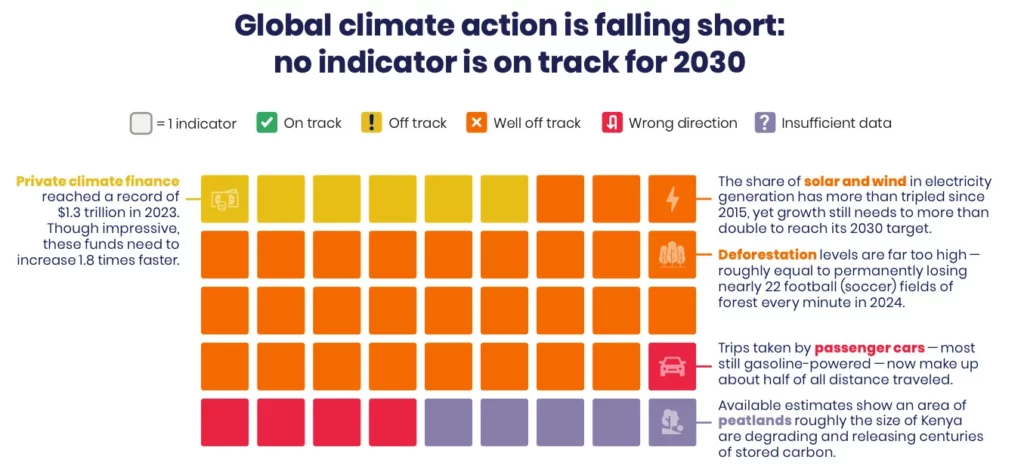
They say:
Halfway through the middle of what the climate community has dubbed the “decisive decade" urgency is fading, vested interests in maintaining the status quo are playing defense as strongly as ever, and complacency is on the rise. [As a result] not one of the 45 indicators assessed is on track to achieve its 1.5°C-aligned benchmark for 2030.
Of course it must be said that, given the current levels of CO2 concentrations in the atmosphere, 1.5ºC is no longer a reasonable target. This was recognised officially for the first time by the UN's Secretary General António Guterres in an interview with The Guardian:
“Let’s recognise our failure. The truth is that we have failed to avoid an overshooting above 1.5C in the next few years."
So now we must look forward to the future. Given that governments have failed to keep global temperatures below 1.5ºC there should now be an urgent renewed commitment to avoid a large overshoot and definitely avoid going beyond 2ºC. Right?
You would think.
Instead the world is showing a complete lack of urgency as manifest by the lackluster submission of Nationally Determined Contributions as stipulated in the Paris Accord. Of the 197 signatories only 67 submitted their NDC's by the September 30th deadline.
Here is are comments by the UN Climate Change Executive Secretary Simon Stiell at the launch of the Nationally Determined Contributions Synthesis Report, released on 28 October 2025.
We are equally mindful that the data set in today's report provides quite a limited picture, as the NDCs it synthesizes represent around one-third of global emissions. In order to provide a wider picture of global progress ahead of COP30, we have done some additional calculations which also capture new NDCs or targets submitted or announced up to publication of this report, and including at the Secretary-General's Climate Summit in New York.
This wider picture, though still incomplete, shows global emissions falling by around 10% by 2035.
What emission reductions are required by 2035 to remain below 2ºC? From the Synthesis Report:
Limiting warming to below 2 °C (with over 67 per cent likelihood), GHG emission reductions will have to be reduced by 35 (22–55) per cent by 2035 relative to the 2019 level.
You read that correctly. To avoid 2ºC a 35% reduction is required. In 2025 parties to the Paris Accord have committed to 10%.
There is an emission reduction gap of 25%.
So basically things have gotten a little worse than was projected in the 2024 UNEP Emissions Gap Report. (The 2025 report not available at time of writing.)
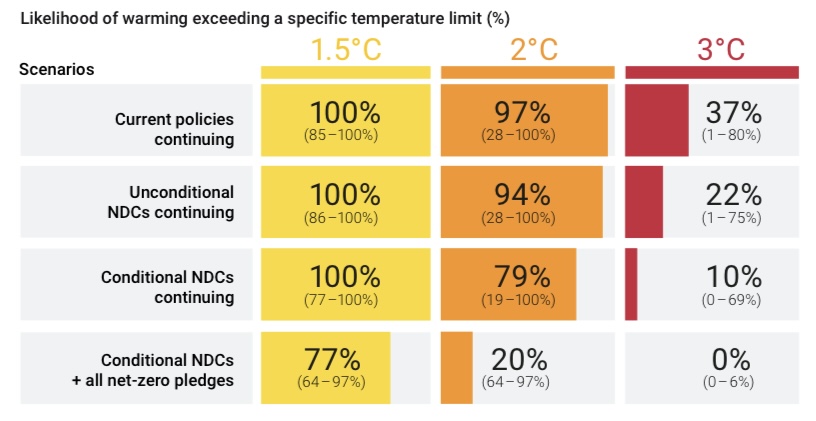
We have to accept that we have catastrophically failed at keeping temperatures below 1.5ºC and now have a ~97% chance (2024 data) of failing at keeping temperatures below 2ºC.
There should now be urgency in implementing adaption plans to be able to cope with a world at 2ºC.
How are things going on the adaptation front?
This from the UNEP Adaptation Gap Report 2025, which provides the annual update on what is happening globally in planning, implementation and finance for adaptation to climate change.
The report updates the cost of adaptation finance needed in developing countries, putting it at US$310 billion per year in 2035, when based on modelled costs. When based on extrapolated needs expressed in Nationally Determined Contributions and National Adaptation Plans, this figure rises to US$365 billion a year. Meanwhile, international public adaptation finance flows to developing countries were US$26 billion in 2023: down from US$28 billion the previous year. This makes adaptation financing needs in developing countries 12-14 times as much as current flows.
If current finance trends continue, the Glasgow Climate Pact goal of doubling international public adaptation finance from 2019 levels by 2025 will not be achieved, while the New Collective Quantified Goal for climate finance is not ambitious enough to close the finance gap.
In other words we are completely off track to deal with the impacts that we are now committed to. As the report cover puts it:
Running on empty. The world is gearing up for climate resilience — without the money to get there.
In response to all this, in a strongly worded BioScience Journal Article entitled The 2025 state of the climate report: a planet on the brink William J. Ripple et al make this observation.
We are hurtling toward climate chaos. The planet's vital signs are flashing red. The consequences of human-driven alterations of the climate are no longer future threats but are here now.
In this report, we seek to speak candidly to fellow scientists, policymakers, and humanity at large. Given our roles in research and higher education, we share an ethical responsibility to sound the alarm about escalating global risks.
Their report has this graphic, which shows that on our current emissions and climate action trajectory we are headed for 3.1ºC by 2100.
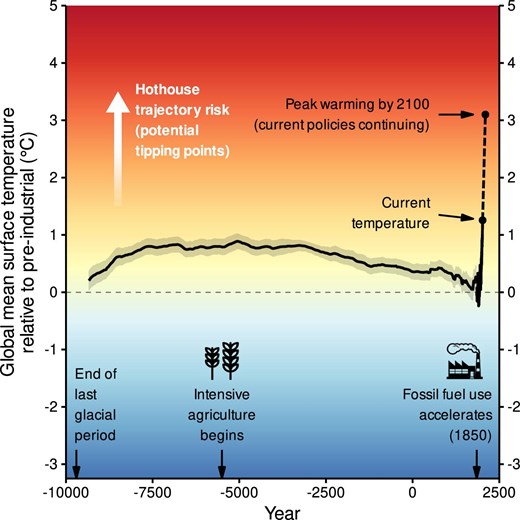
Of course it is a journey to get to that level of heating: 1.5ºC now, then 1.6ºC then 1.7ºC then 2ºC by 2038 or so. Each increment of heating resulting in more climate chaos.
William J. Ripple et al conclude:
The accelerating climate crisis is now a major driver of global instability. Extreme weather is causing widespread impacts and direct loss of life, while also driving resource scarcity, displacement, and civil unrest. These challenges are further compounded by weakening international cooperation and reductions in foreign aid. These converging pressures are straining national governments, multilateral institutions, and communities around the world. A strategy that embeds climate resilience into national defense and foreign policy frameworks is urgently needed. Without it, cascading risks may overwhelm systems of peace, governance, and public and ecosystem health.
To ensure a livable and just future, we must confront the deeper challenge of aligning human civilization with the limits of the Earth's natural systems. Transformative change is needed to address ecological overshoot and the worsening climate emergency. This includes reducing overconsumption, particularly among the affluent, stabilizing the human population through the empowerment of girls and women, shifting toward plant-based food systems, providing safe water and sanitation to all, and adopting economic models that prioritize well-being, equity, and sustainability over perpetual growth (Ripple et al. 2020, Gupta et al. 2024). These systemic shifts are necessary to safeguard the biosphere and promote long-term well-being.
Are we up for this?
So far there is no indication that this situation is being treated as a global emergency.
We are, to quote António Guterres, on a highway to hell with our foot firmly on the gas.
But there is something we can do about this. Here are 5 bold steps we could take in the next 12 months.