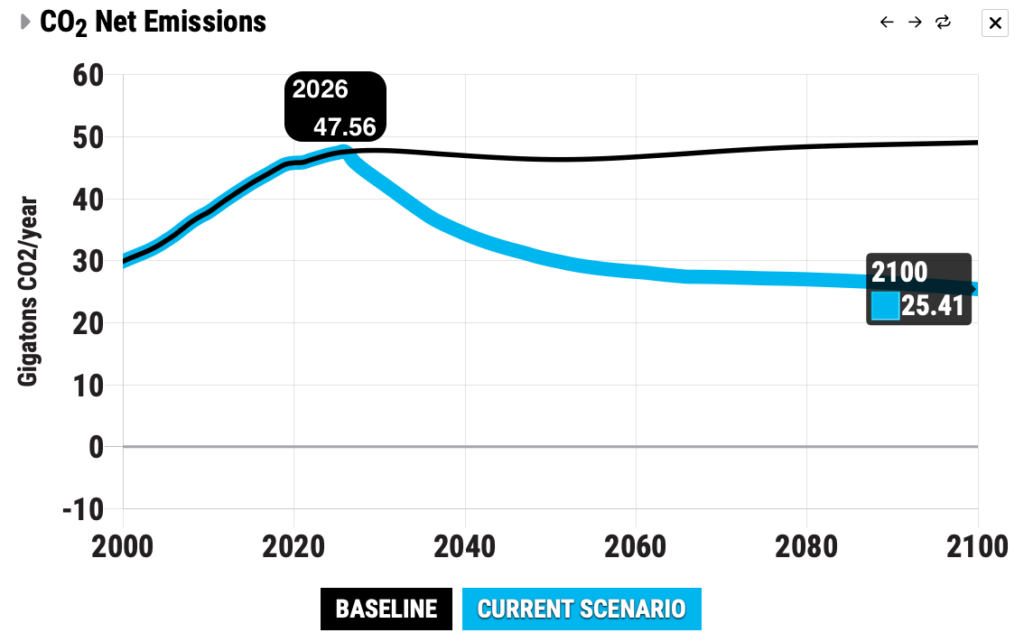
Oil is the second dirtiest fossil fuel next to coal.
Being able to destroy demand for oil will make a dramatic impact on our current emissions trajectory, especially when combined with demand destruction for coal, and we have the technology to do it!

The Solution
The transportation sector is the largest consumer of oil globally, accounting for over 60% of total global oil demand according to the International Energy Agency (IEA).
Let us focus our attention on this sector and see what is already happening to destroy the demand for oil.
When looking at reducing emissions in any sector, there is a framework that is helpful in pinpointing what actions can be taken. The strategy framework is referred to as "Avoid, Shift, Improve." Let’s use this to see how it is being applied to the transportation sector.
Avoid
This is straightforward. Anything that can be done to avoid the need for oil/diesel motorised trips falls into this category. A major strategy here is active mobility, where instead of driving, individuals either walk or cycle to their destinations.
Example Paris
Under the leadership of Mayor Anne Hidalgo, Paris has executed one of the most aggressive urban space reallocations in modern history. Using the Bicycle Plans (Plan Vélo), the city has systematically dismantled car-centric infrastructure to encourage active mobility. To make room for active mobility, Paris removed major vehicle lanes and eliminated over 60,000 on-street car parking spaces. Major arterial roads, such as the left-bank highway along the Seine River, were closed entirely to cars and transformed into linear parks for pedestrians and cyclists.
As a result between 2018 and 2023, bicycle traffic in Paris surged by approximately 240%!

Today the streets of Paris are explored on foot and by bicycle by hundreds of thousands of people. The decline in internal combustion engines resulted in a 45% reduction in air pollution (Nitrous Oxide) levels across the capital, profoundly changing the visible smog profile over the cityscape and improving peoples health!
Improve
Switching internal combustion engines (ICE) to electric vehicles delivers the single largest technological jump in energy efficiency available today. Electric vehicles (EVs) convert over 75% to 85% of electrical energy from the grid directly into power at the wheels. By comparison, conventional petrol and diesel vehicles waste most of their energy as ambient heat, operating at an efficiency of only 20% to 30%.
The EV revolution
The global electric vehicle (EV) revolution is accelerating faster than ever, with 2025 marking a historic milestone: over 20 million electric cars sold, accounting for 25% of all new car purchases worldwide.
- China has led the charge, with 55% of its car sales now electric.
- Europe saw a 30% surge in EV adoption, pushing its market share to 28%.
- Emerging markets are catching up! Southeast Asia’s EV sales doubled in 2025, and Latin America experienced a 75% growth spike.
Projections for 2026 (via IEA):
- 23 million EVs expected to sell, representing 28% of global car sales.
- By 2035, EVs could dominate half of all new car sales, with China and Europe potentially hitting 90%+ adoption rates.
This shift isn’t just about passenger cars. Electric trucks, buses, and two/three-wheelers are also gaining traction, with China’s electric truck market growing so rapidly that 1 in 4 trucks sold in 2025 were electric.
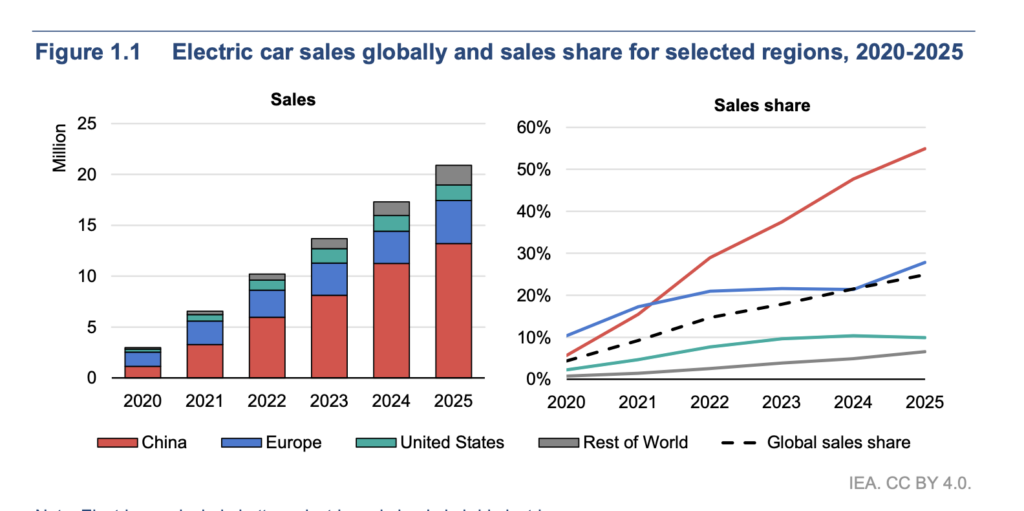
The emissions impact of this transition is already substantial!
- In 2025 alone, EVs displaced 1.7 million barrels of oil per day, equivalent to ~1.7% of global oil demand, primarily in China and the EU.
- By 2030, this figure could triple to 5 million barrels per day, with electric trucks alone contributing 1 million barrels per day by 2035.
- The climate benefits extend way beyond oil. As grids decarbonize and battery production becomes cleaner, the lifecycle emissions of EVs continue to shrink.
As a side note for countries heavily reliant on oil imports, like China (the world’s largest oil importer), the shift to EVs is also a strategic move toward energy security.
Shift
Moving passengers and freight away from private cars and commercial trucks onto shared high-capacity transit networks drastically lowers the energy footprint per passenger-kilometer or ton-kilometer. Many cities and connections between cities are now serviced by electric train networks.
Example Europe
- Virtually 100% of its dedicated high-speed rail networks are powered by electric energy.
- While rail carries 7% of all European passengers, it accounts for a mere 0.4% of total EU transport greenhouse gas emissions according to the European Environment Agency.

We have the solutions to destroy oil demand in the transport sector, and this is already happening, but as always, we just need to go faster!
If we combine the move away from coal with the rapid changes now happening in the transport sector, using the Avoid, Shift, Improve framework, we can shave another 8 GtCO₂ of emissions! Together radically reducing the use of these two fossil fuels we could drop emissions from where they are today by a massive 44%.
There is no reason not to do this!