
The chart above is a clear snapshot of where things stand.
Under current policies, the chance of keeping warming below 2°C is very low. Even if countries follow through on existing commitments, the probability only improves to somewhere between about a quarter and a third. It is only when full net-zero pledges are assumed to be delivered that the odds move closer to something more reassuring.
This is the reality we face.
At the same time, global emissions remain near record highs at about 57.7 Gt CO₂e in 2024. Observed warming has already reached roughly 1.5°C above pre-industrial levels. Each year of continued high emissions reduces the remaining space to act.
Taken together, the picture is straightforward. Staying below 2°C is still possible, but it depends heavily on what happens now.
The gap between urgency and action
Climate change is widely described as urgent as determined by the science.
The response has not matched that language.
Carbon dioxide continues to accumulate in the atmosphere. High emissions today make it harder if not impossible to attempt to stabilise temperatures later.
This does not mean the outcome is already decided. But it does mean that the margin for error is shrinking rapidly.
What we choose to normalise
Most of the focus today sits on policy, technology, and investment and make no mistake those are central to reducing emissions. But there is also a cultural layer that shapes how seriously the problem is taken and how fast we move.
What we celebrate absolutely matters.
Events like the Simola Hillclimb are a good example. In isolation, the emissions from this event are small. They do not determine the global total. But they are visible and they shape perception.
A high-performance event built around fossil fuel use reflects a world that is being left behind. It keeps one foot in a past way of doing things that the science is asking, indeed demanding we move away from.
This is not about assigning blame by the way. It is about recognising there is a mismatch between the direction of travel and what remains “normal” in public life.
What a different version of the Simola Hillclimb could look like
It is easier to point out the problem than to describe the alternative. But the alternative is not that hard to imagine.
A future version of the Simola Hillclimb could look very different while still holding onto what makes it appealing.
The cars themselves would change first.
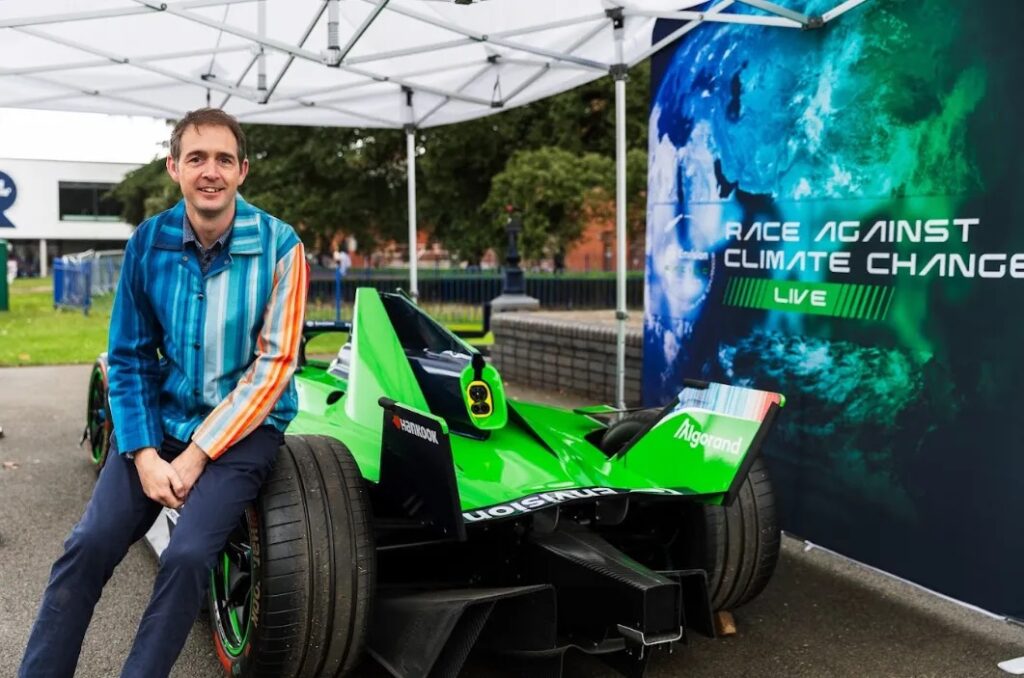
Electric performance vehicles already deliver the kind of acceleration and precision that motorsport demands. Competition would shift toward efficiency, battery management, and new forms of engineering advantage. The experience would evolve, but the core idea of pushing limits would remain.
The logistics behind the event would follow.
Transporting cars, equipment, and teams could move toward lower-carbon freight options, supported by better planning and less unnecessary movement. More could be sourced locally. Setups could be designed to reduce the need for repeated long-distance transport.

Visitors would arrive differently as well.
Shared transport, electric vehicle access, and coordinated travel options would reduce the footprint of getting to and from the event. As the broader transport system changes, this becomes easier to do.
Energy use on site would shift.
Temporary infrastructure could be powered through renewable sources rather than diesel generators. This is already possible in many contexts.
None of these changes require new inventions. They require a decision to change direction!
Why this shift matters
This is not about singling out the Simola Hillclimb event but it is about illustrating how it could align with where we need to go.
The chart at the beginning makes it clear that stronger action across society improves the odds of staying below 2°C. That includes large systems like energy and transport, but also the visible signals that shape how the need for this change is understood.
When public-facing activities reflect the transition we need to make, they reinforce it. When they do not, they make it easier to treat the needed urgent transition as something distant or worse optional.
A future that is still within reach
The risks of inaction are not theoretical. As warming increases, so do the impacts. Floods, droughts, fires, and economic disruption are already being observed in many regions. These risks grow with each increment of warming.

But the outcome is not fixed—yet.
There is still space to change the emissions trajectory we are on. The speed depends on decisions made over the next few years, across policy, infrastructure, investment, and everyday choices about what is supported and what is not.
Events like the Simola Hillclimb sit within that broader picture. They can either remain tied to an old model that no longer serves us or become part of the new one we need to step into.
The window for course correction is still open. What action we take or don’t take from here on in will determine where we end up.
In the words of Chris Packham don’t let anyone tell you this is not possible!