This post will be Knysna specific to illustrate how water stress should be thought about.
The town and its surrounds has just experienced its lowest annual rainfall in the 1979–2025 record. That is a serious data point.
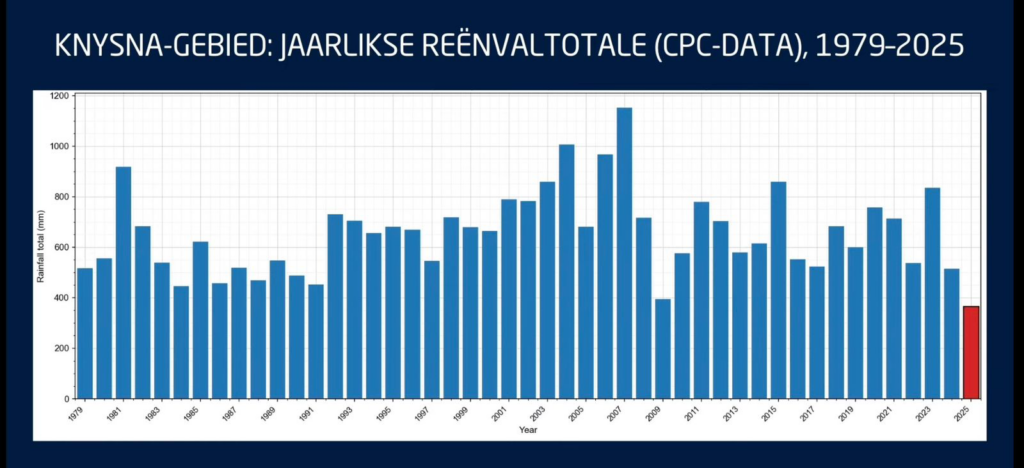
But a single record low year does not automatically mean that rainfall is collapsing or that climate change has already transformed the rainfall regime. The long-term rainfall record still shows high natural variability from year to year.
So the more important question is this:
What actually turns a dry period into a true water crisis?
A recent global study on “Day Zero Drought” events, the kind of compound crisis that nearly shut down Cape Town’s taps in 2018, offers a useful framework for thinking about this.
The key insight from that research is simple but important:
Water crises are usually not caused by rainfall declines alone.
They happen when several stresses occur at the same time.
Let's translate this into what has been observed in Knysna recently.
Water risk is a compound problem
The study defines “Day Zero Drought” as a compound event—meaning multiple pressures overlap.
Those pressures include:
- Prolonged low-rainfall periods
- Reduced river flows
- Demand exceeding supply
- Reservoir storage being unable to buffer the deficit
This understanding matters a lot because annual rainfall totals on their own can hide what is really happening in the system.
A region can experience:
- No clear long-term rainfall decline
- But increasing evaporative demand due to warming
- Shorter river recovery periods
- Growing water consumption
- Infrastructure losses
And still tip into a water security crisis.
What this means in Knysna's case
Instead of asking only "is rainfall declining?" a more useful question to ask is "is the town's water system becoming more vulnerable to compound stress?"
Based on this line of questioning and observations since early November there are four pillars that determine the towns real risk
Pillar 1: Atmospheric Stress (Rainfall + Heat)
Low rainfall matters obviously, but so does any accompanying heat.
Warmer conditions increase evaporation from soils, dams, and vegetation. That means the same rainfall total today may produce less effective runoff than it did decades ago.
Even without a dramatic long-term rainfall collapse, increased evaporative demand can intensify drought stress.
Pillar 2: River Persistence
The Knysna River and its tributaries are the lifeblood of the town's water system.
What matters is not just whether rain falls, but:
- How long river flow persists after rainfall
- How quickly levels drop back to critical thresholds
- Whether baseflow survives dry spells
Rapid spike-and-collapse patterns reduce the system’s buffering ability.
Pillar 3: Supply vs Demand
A key finding in the study mentioned above is that water scarcity is often driven as much by demand as by climate.
If demand remains high while supply falls, the imbalance then obviously accelerates reservoir depletion.
In Knysna’s case, provincial briefings have highlighted extremely high non-revenue water losses (over 50%), meaning a significant portion of treated water never reaches consumers. That amplifies stress during dry periods.
A fragile supply-demand balance makes even normal variability dangerous!
Pillar 4: Storage Buffer
Reservoirs exist to provide a safety net during dry periods.
But when dry conditions persist longer than the system’s storage buffer can sustain, risks escalate rapidly.
The research shows that when drought duration exceeds reservoir resilience, acute scarcity can follow—especially if demand remains high.
So is Knysna already in a climate-driven shift?
Based on rainfall totals alone, we cannot say that a statistically significant long-term drying trend is clearly visible in the 1979–2025 data shown above.
However:
- 2025 being the driest year in the record most definitely increases the system's exposure.
- Southern Africa is identified in modelling as a hotspot for emerging compound water scarcity risks.
- Climate change is projected to increase evaporative demand and multi-year drought persistence.
What this means is that the probability of compound stress events increases as we continue to heat.
An accurate way to frame the risk
The honest, evidence-based assessment for the area is:
“Knysna’s water system is highly sensitive to extreme variability, and climate change increases the likelihood that when a dry sequence occurs, the system will struggle to cope.”
This should focus attention where it belongs: on building resilience as soon as possible.
What does building resilience look like?
If compound stress is the real risk, then Knysna's resilience depends on:
- Reducing non-revenue water (NB)
- Managing demand proactively (early restrictions are better than late)
- Protecting river baseflows
- Strengthening storage and operational flexibility
- Planning for multi-year variability, not just annual totals
The projected climate signal does not need to show up as a dramatic rainfall collapse to increase risk. Sometimes it shows up as shorter recovery windows and thinner safety margins.
This is the conversation Knysna should be having.