The WMO recently said this about Earth's Energy Imbalance (EEI):
This is precisely why the EEI matters. It provides a direct measure of how far the climate system is from a steady state and is arguably the single most fundamental metric for assessing the status of climate change.
They explain what EEI is:
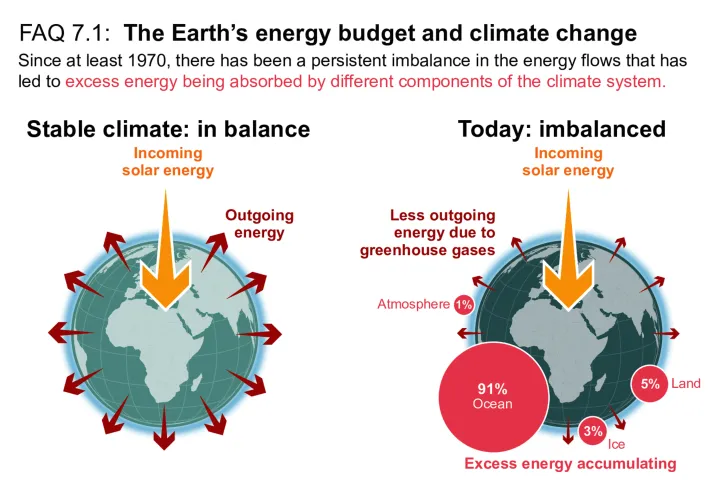
Earth continuously receives energy from the Sun at the top of the atmosphere – about 340 watts per m2 averaged over the entire planet – mostly in the form of shortwave radiation. In a balanced climate, Earth returns an equivalent amount of energy to space. Some of this energy leaves as reflected sunlight, bounced back by clouds, ice, snow and the Earth’s surface; the remainder leaves as longwave, or thermal, radiation emitted by the surface and atmosphere (Fig 1, left panel).
Over the past 150 years, however, human activities have disturbed this balance. Emissions of greenhouse gases and aerosols, together with changes in land use and land cover, have altered the amount of energy Earth emits and reflects back to space. Greenhouse gases act as a partial lid on the planet’s thermal radiation, reducing the amount of heat escaping to space, while incoming sunlight remains essentially unchanged. The result is a small but persistent surplus: Earth is now absorbing more energy than it releases (Fig 1, right panel).
This net imbalance, known as Earth’s energy imbalance (EEI), is measured at the top of the atmosphere and currently stands at roughly 0.9 watts per m2, averaged over the past 20 years. This means each m2 of Earth is gaining almost one additional watt of energy compared with the amount it loses to space, continuously, day and night.
A rising EEI indicates that heat is accumulating in Earth's climate system at an increasing rate or, in other words, that global warming is accelerating.
This is the background against which normal weather events are now taking place and helps explain the extremes we are seeing in the form of extreme precipitation and intense heatwaves.
Urgent adaptation measures are now necessary to avoid loss and damage as much as possible.
Our infrastructure is not built for this new climate.