Yesterday South Africa announced it's Integrated Resources Plan 2025
Here is the full press briefing.
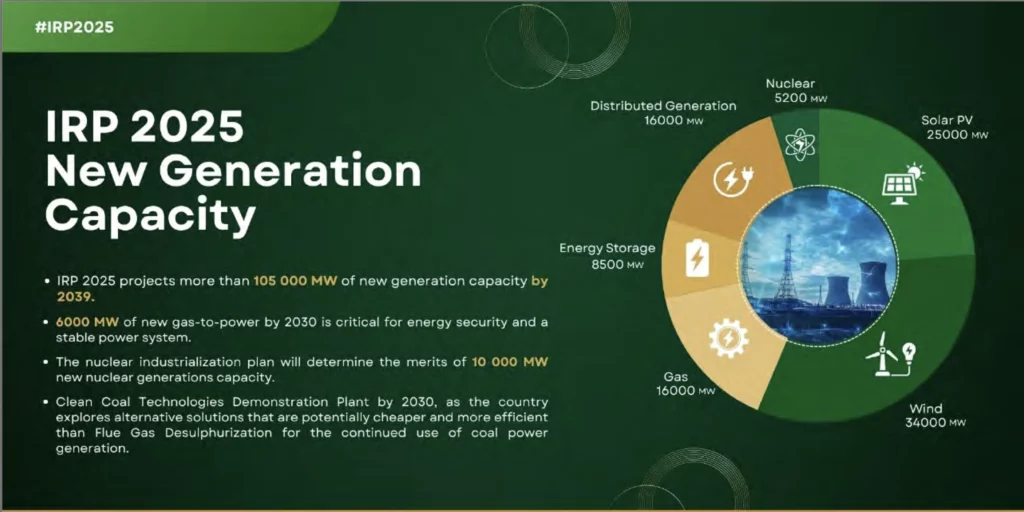
The plan projects more than 105,000 MW of new generation capacity by 2039. This is new capacity build is ambitious even by global standards. Here is the plan in a nutshell:
This marks a big turning point in the country’s energy future. For the first time, the government has mapped out a realistic path to reduce coal’s dominance and ramp up renewables, storage, and distributed generation.
That’s the good news and it’s genuinely significant. But buried in the same document is a line about a “Clean Coal Technologies Demonstration Plant by 2030.”
And that one sentence says a lot about the political balancing act still shaping the country's energy transition.
The progress worth celebrating
As mentioned the IRP outlines plans to build more than 105 000 MW of new generation capacity by 2039, including:
- Wind 34,000 MW
- Solar PV 25,000 MW
- Energy Storage 8,500 MW
- Gas 16 000 MW
- Distributed Generation 16,000 MW
- Nuclear 5,200 MW
If the government delivers on this plan, coal’s share of electricity generation will fall from about 58% today to 27% by 2039. This is a fundamental shift and an essential step toward decarbonisation of energy system.
The problem with "clean coal"
The IRP also proposes a Clean Coal Technologies Demonstration Plant to be built by 2030, which they describe as an “alternative solution that is potentially cheaper and more efficient than flue gas desulphurization (FGD).”
This may sound promising until you unpack what it really means.
- There is no truly “clean” coal technology. Carbon capture and storage and gasification systems exist in theory, but they’re expensive, energy-intensive, and not commercially viable at scale.
- FGD is a proven pollution-control system that reduces sulphur dioxide emissions and improves air quality. Avoiding it in favour of an unproven “clean coal” experiment is not innovation it's cost avoidance!
- Politically, the “clean coal” clause is a way to reassure coal-dependent regions and unions that coal still has a future, even as the rest of the plan moves toward renewables.
In short, this is a greenwashing move, a political fig leaf that allows policymakers to say “we’re exploring clean coal” without having to face the full implications of phasing it out.
Why it matters for South Africa’s Just Energy Transition
South Africa’s Just Energy Transition Partnership (JETP) backed by over USD 8.5 billion in international climate finance is built on a clear premise:
- A managed coal phase-down, combined with rapid investment in renewables and community-level support for affected regions.
- Introducing “clean coal” language muddies that message.
- It risks undermining donor confidence, slowing funding disbursements, and signalling that South Africa isn’t fully committed to the transition path it agreed to under the JETP and its net-zero by 2050 goal.
The plan forward
The IRP 2025 deserves credit for its scale and ambition, especially the focus on wind, solar, storage, and distributed generation.
But for the plan to retain credibility South Africa must:
- Treat the “clean coal” plant strictly as a research pilot, not a backdoor to extend coal’s lifespan.
- Prioritise air-quality compliance and install FGDs at existing coal plants to protect public health.
- Accelerate renewables procurement and grid investments to close the energy gap left by coal retirements.
- Maintain transparency in funding and timelines for all “clean coal” or CCS-related projects.
The bottom line
The IRP 2025 is a big step in the right direction but the “clean coal” clause should remind everyone that South Africa’s energy transition is still walking a tightrope between progress and politics.
Real leadership means making hard choices by aggressively removing coal from the energy mix.not hiding behind hopeful CCS slogans.