Since atmospheric greenhouse gas concentrations drive global warming, these are ultimately the metrics that matter. This simple line from the Emissions Gap Report 2025 captures the core truth of climate science: everything else, from extreme weather to sea-level rise, flows from the amount of heat trapped in the atmosphere.
As we pass the midpoint of this decade, the latest scientific assessments show a world that is heating faster, losing ice faster and struggling to adapt. The evidence from the five major reports released in the last few weeks paints a stark picture of where we stand.
Here is a summary.
Greenhouse gases at record highs
The State of the Climate 2025 update confirms that CO₂ reached 423.9 ppm in 2024 (projected to reach 425.7 ppm in 2025), these concentrations are the highest in the observational record, with a record annual increase of 3.5 ppm from 2023 to 2024. Methane and nitrous oxide also reached new peaks. All three gases have continued rising into 2025, reinforcing the upward trend in radiative forcing.
These concentrations are not just abstract numbers; they are the physical drivers of warming. They define the long-term trajectory the climate system is locked into.

2025: Among the warmest years ever recorded
Global mean temperature from January to October 2025 averaged 1.47°C above pre-industrial levels in the ERA5 dataset. This puts 2025 on track to be the second or third warmest year on record. The past eleven years, from 2015 to 2025, will all rank as the eleven warmest in the instrumental record.

Oceans absorbing unprecedented heat
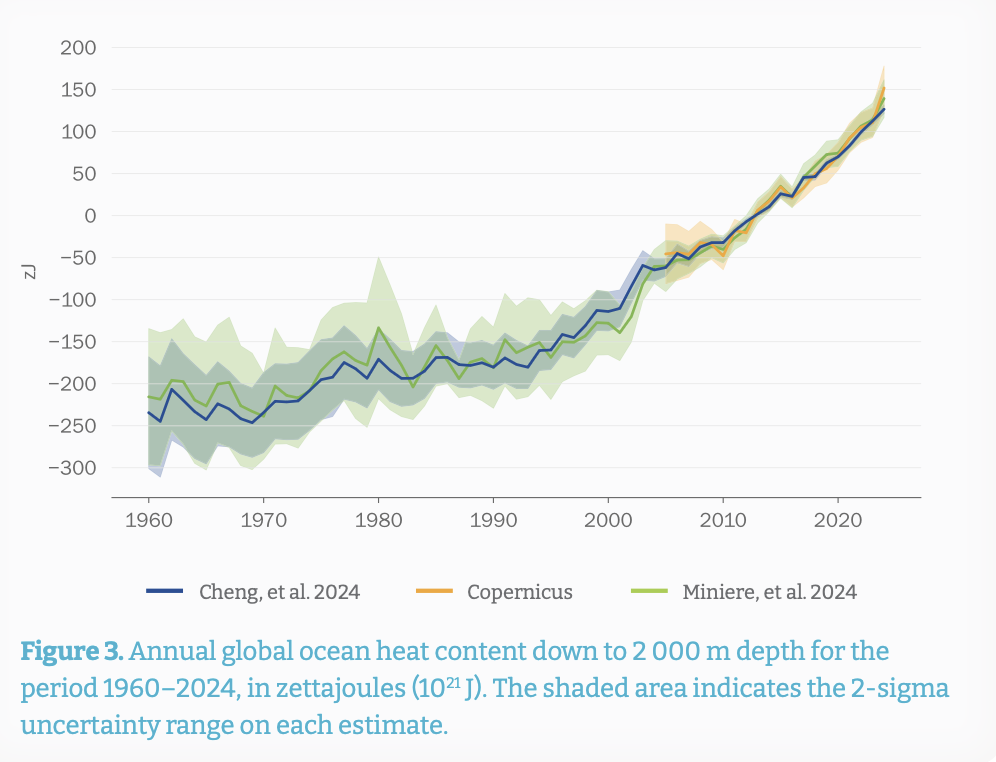
Over 90% of excess heat caused by greenhouse gases is stored in the ocean. Ocean heat content reached its highest level ever recorded in 2024 and continued rising in early 2025. Warming rates in the last two decades have been especially rapid, confirming that the Earth system is in a strong energy imbalance.
This rising heat accelerates sea-level rise, bleaches coral reefs and drives stronger tropical storms, like Melissa that devastated Jamaica and Fung-wong that destroyed parts of the Philippines.
Cryosphere collapse accelerating
Glaciers continued their steep decline. The hydrological year 2023–2024 saw a record global glacier mass loss of 1.3 metres water equivalent, equal to 450 gigatonnes and about 1.2 mm of global sea-level rise. This is the largest loss on record since 1950. 
Arctic sea ice reached its lowest annual maximum in the satellite record in March 2025. Antarctic sea ice extent also remained well below average. 
The State of the Cryosphere Report shows that many mid-latitude glacier systems are committed to losing most of their ice even at 2°C of warming, with severe consequences for global water security.


Extreme events intensifying
By August 2025, severe droughts, heatwaves, floods and cyclones had caused major impacts across every region, damaging croplands, displacing communities and eroding livelihoods. The interconnected risks highlighted in the State of the Climate update show how climate change is now influencing food security, health and humanitarian outcomes at scale.
The emissions gap: 1.5°C has slipped out of reach
The Emissions Gap Report 2025 provides the clearest assessment yet of where current government commitments lead. Under present policies, the world is heading for around 2.8°C of warming by 2100. According to the report, even if all conditional pledges were fully implemented, the best-estimate peak warming is about 1.9°C.
The uncomfortable truth is that the chance of exceeding 2°C in the next 15-20 years is extremely high. Some scenarios show a 92% likelihood of passing the 2°C threshold based on current commitments. In order to be on a 2ºC pathway emissions must fall 6-7% every year for the remainder of this decade.

Adaptation needs are rising faster than finance
The Adaptation Gap Report 2025 estimates that developing countries will require US$310–365 billion per year (constant 2023 prices) for adaptation by 2035. Current international public and private flows fall far below this. Even the new global finance goal of US$300 billion by 2035 will not be enough to meet needs, especially once inflation is accounted for.
Significant volumes of concessional public finance will be required to leverage private investment because market-based solutions alone cannot cover the scale or urgency of need. 

What now? Preparing for a hotter world
We are moving into a period where overshooting 1.5 °C is 100% certain and where exceeding 2°C is 92% certain. We need an immediate course correction. The implications of all this is profound: more extreme weather, more pressure on water and food systems, faster cryosphere loss and rising sea levels for centuries.
Adaptation is now essential, not optional. Based on the evidence in this years reports, preparation should focus on:
- Scaling early warning and climate information services, which already save lives but still do not reach 40% of countries.
- Helping people and animals with cooling that live in places that are already close to thermal limits.
- Clearly identifying areas that are at increased risk of flooding, especially places close to seasonal rivers. Help people have a path to higher ground in these areas.
- Strengthening coastal planning, including nature-based protection and, where necessary, phased approaches to relocation for places that are threatened by repeated storm surges and continuing sea-level rise.
- Increasing adaptation finance quickly, recognising that private finance cannot fill the gap alone and that concessional flows must grow to meet the demand.
The path ahead requires accelerated mitigation and far greater investment in resilience.
Remember atmospheric greenhouse gases remain the ultimate metric that matters. As long as they continue to rise, the planet will continue to heat. Our task now is to limit this rise as quickly as possible while building the capacity to live safely in a world being transformed in real-time.
Are we up to the challenge?