The latest water sampling conducted on 19 February 2026 across the Knysna Estuary and several urban culverts provides another snapshot of estuary water quality conditions. As always the samples were analysed by an independent laboratory to measure E. coli, a commonly used indicator of faecal contamination in water and the results speak for themselves really.
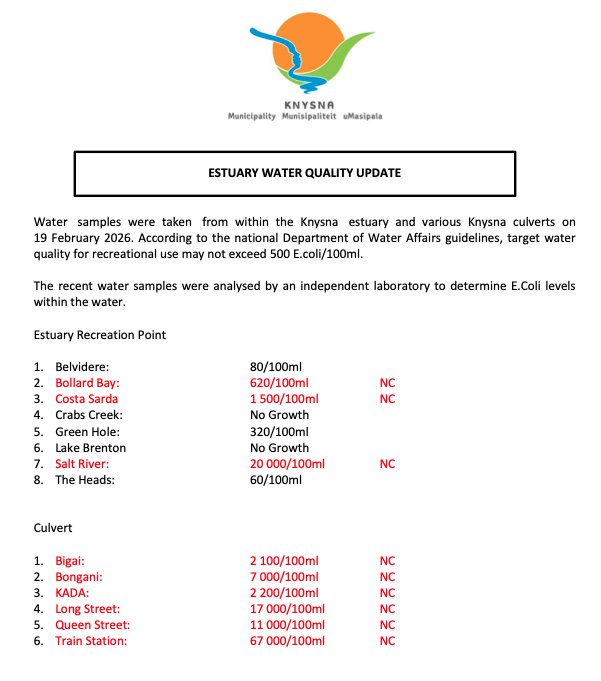
As you can see above, the results show a mixed but largely familiar pattern, and when viewed alongside monitoring results throughout 2025, they help clarify how the estuary system is behaving in the face of pollution.
Much of the estuary remains within safe limits
Several popular estuary locations recorded low E. coli levels, well within recreational guidelines.
Recent results include:
- Belvidere: 80 /100 ml
- Crabs Creek: No growth detected
- Lake Brenton: No growth detected
- The Heads: 60 /100 ml
These values fall comfortably below the recreational guideline threshold.
This pattern has also been visible across much of the 2025 monitoring, where locations such as Belvidere, Crabs Creek, Lake Brenton and The Heads consistently recorded low bacterial levels during most sampling rounds.
The reason is largely physical: the estuary benefits from strong tidal flushing, which helps dilute and move contaminants through the system.
In other words, despite pollution inputs from parts of the catchment, the estuary still retains a significant capacity to disperse contaminants.
Areas With Elevated Readings
Some locations continue to show periodic spikes above recommended recreational limits.
In the February sampling these included:
- Bollard Bay: 620 /100 ml
- Costa Sarda: 1,500 /100 ml
- Salt River: 20,000 /100 ml
The Salt River reading is particularly high, at roughly 40 times the recreational guideline.
Looking back through the 2025 monitoring data, Salt River has repeatedly recorded elevated readings—including 73,000, 330,000 and even 850,000 E. coli per 100 ml in different months.
This recurring pattern strongly suggests that a persistent contamination source exists somewhere upstream in the Salt River catchment.
The available data does not identify the exact source, but elevated E. coli levels of this magnitude are typically associated with inputs such as:
- sewage infrastructure failures (most likely)
- sewer leaks entering stormwater systems
- informal sanitation runoff
- agricultural or animal waste
Without a proper investigation, the precise source cannot be confirmed.
Stormwater culverts remain highly contaminated
Sampling of urban culverts once again shows extremely high bacterial levels.
For example, the February results recorded:
- Train Station culvert: 67,000 /100 ml
- Long Street culvert: 17,000 /100 ml
- Queen Street culvert: 11,000 /100 ml
Throughout 2025 monitoring, culverts regularly showed values ranging from thousands to millions of E. coli per 100 ml. 
This is unfortunately typical of urban stormwater drainage systems, which often collect contaminated runoff before discharging into rivers or estuaries.
Stormwater can carry:
- sewer leaks
- septic seepage
- pet and wildlife waste
- informal sanitation runoff
- other urban pollution
When rainfall occurs, these systems can deliver pulses of contaminated water into the estuary.
Reports of sewage spills in town
Every week this year many residents have reported sewage spills in streets and public areas across Knysna. While these incidents are separate from the estuary monitoring programme, they are important to acknowledge because untreated sewage presents a direct public health risk.
Raw sewage can contain high concentrations of bacteria and other pathogens. Direct contact should always be avoided, especially any standing water in streets and any contaminated areas should be reported to the municipality so they can be addressed as quickly as possible.
Urban sewage spills can also enter stormwater drainage systems, which typically discharge into rivers or the estuary. As the monitoring results consistently show there are extremely high bacterial levels in several stormwater culverts feeding into the estuary.
While the available monitoring data does not identify the exact source of this contamination, repeated sewage spills increase the risk that polluted water may eventually reach local waterways.
Health guidance for residents and visitors
When water quality exceeds recreational guidelines, it does not automatically mean the entire estuary is unsafe, but it does mean people should take basic health precautions.
The following simple measures significantly reduce risk:
Avoid Ingestion
Avoid swallowing estuary water and try to prevent water from entering the mouth, nose, or eyes, particularly in areas where elevated bacterial levels have been recorded.
Wash After Contact
Anyone who comes into contact with estuary water — especially in higher-risk areas such as the Waterfront marina or Ashmead Channel should wash thoroughly with clean potable water and soap afterward.
Avoid Entering With Open Wounds
Do not enter the water if you have open cuts, sores or fresh wounds, as these can provide direct entry points for bacteria including E. coli.
Extra Care for Vulnerable Groups
Children, elderly individuals, and people with weakened immune systems should avoid contact with the water when “not fit for recreational use” advisories are active.
These precautions are standard public health guidance for any natural water body experiencing elevated bacterial levels.
Stay safe.