At the Garden Route Environmental Forum’s Extreme Weather Reflection Summit on Thursday 2 July, Ebbe Rabie, founder and CEO of Tiger Risk, delivered a presentation titled Insurance Industry Perspective on Recent Events and Preparing for a Changing Climate. Its central message was straightforward: repeated extreme-weather losses are changing how insurers and reinsurers assess the Garden Route.
The Garden Route is being assessed as a high-loss region
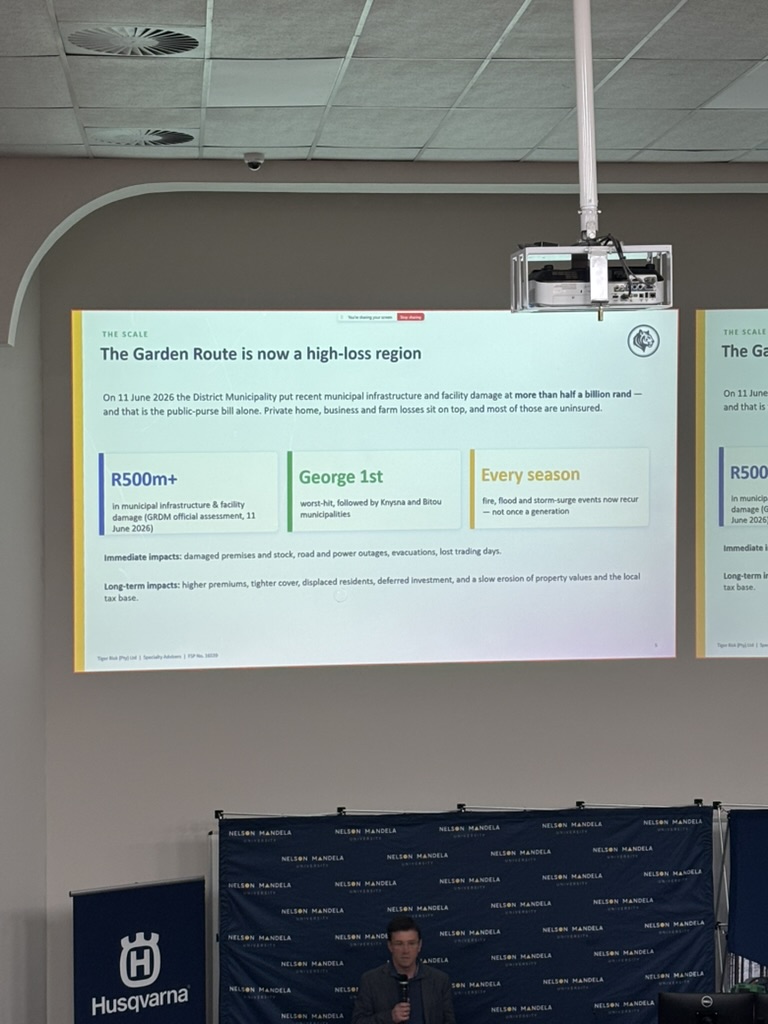
The presentation placed the recent events in a wider sequence: the 2017 Knysna fires, floods and storm surge in 2022–23, the July 2024 cut-off low, and the May 2026 extreme rainfall event. The presentation cited a Garden Route District Municipality assessment of more than R500 million in municipal infrastructure and facility damage from the May event alone, excluding the wider losses borne by households, businesses and farms.
The key concern is recurrence. Fire, flood and storm-surge losses are no longer treated as once-in-a-generation shocks. When damaging events arrive repeatedly, insurers do not assess each one in isolation. They reassess the expected cost of future claims across the whole area.
That can mean higher premiums, higher excesses, narrower terms, stricter underwriting and, in the most exposed locations, reduced willingness to offer cover at all.
The real cost of a disaster extends far beyond physical damage
The presentation described three waves of loss. The first is the immediate shock: damaged buildings and stock, closed roads, power and water outages, evacuations and lost trading days.
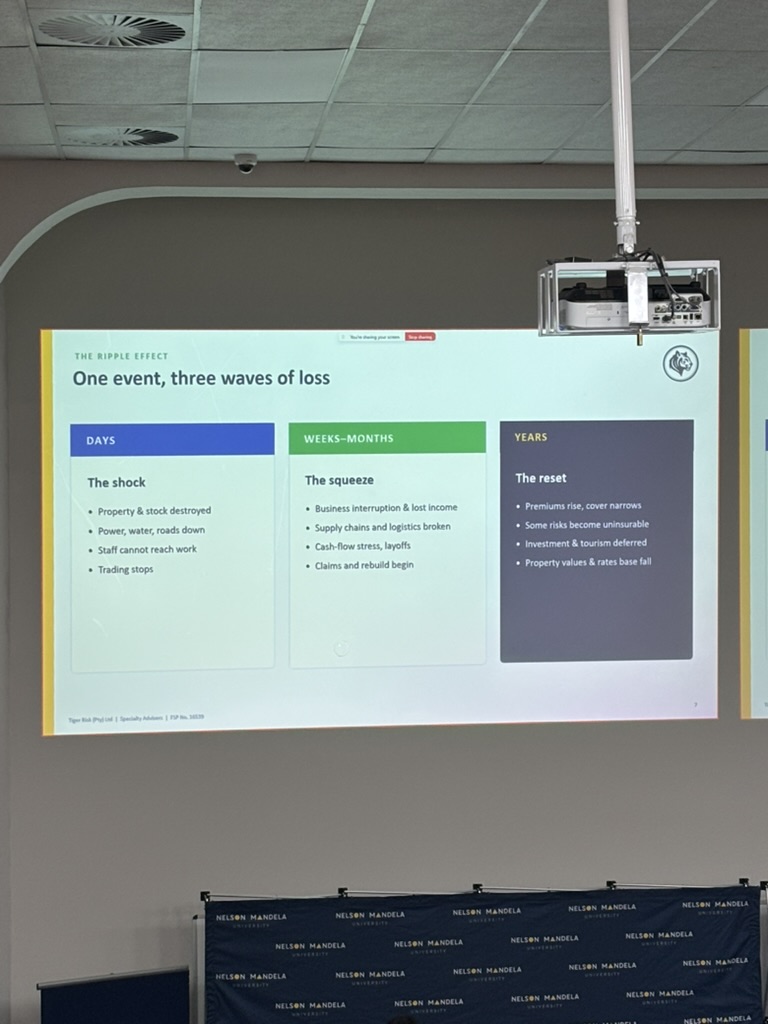
The second arrives over weeks and months. Businesses can face disrupted supply chains, reduced visitor numbers, inability to access premises, cash-flow pressure, layoffs and delayed rebuilding. For a tourism-dependent region, this matters deeply. A business that misses a peak trading period may not recover that lost income later in the year.
The third wave can last for years. Premiums rise, exclusions expand, investment is deferred, property values come under pressure and municipal budgets are stretched by repeated repair costs. This is where climate risk begins to affect the local economy’s capacity to recover between events.
Business interruption is often the hidden vulnerability
One of the most useful points in the presentation was its focus on business-interruption insurance. Property insurance may rebuild a damaged wall or replace equipment, but it does not automatically keep a business alive while roads are closed, utilities are unreliable, contractors are scarce or customers cannot reach the area.
The presentation warned that many businesses may have indemnity periods that are too short for a regional disaster. A six-month period may be insufficient where rebuilding capacity is constrained across multiple towns and supply chains remain disrupted. It also highlighted under-declared gross profit, missing cover for supplier failure or denial of access, and the absence of a tested continuity plan.
For businesses in Knysna, George, Plettenberg Bay, and the wider Garden Route, reviewing these details is increasingly as important as reviewing the building sum insured.
Insurers are moving to more granular risk assessment
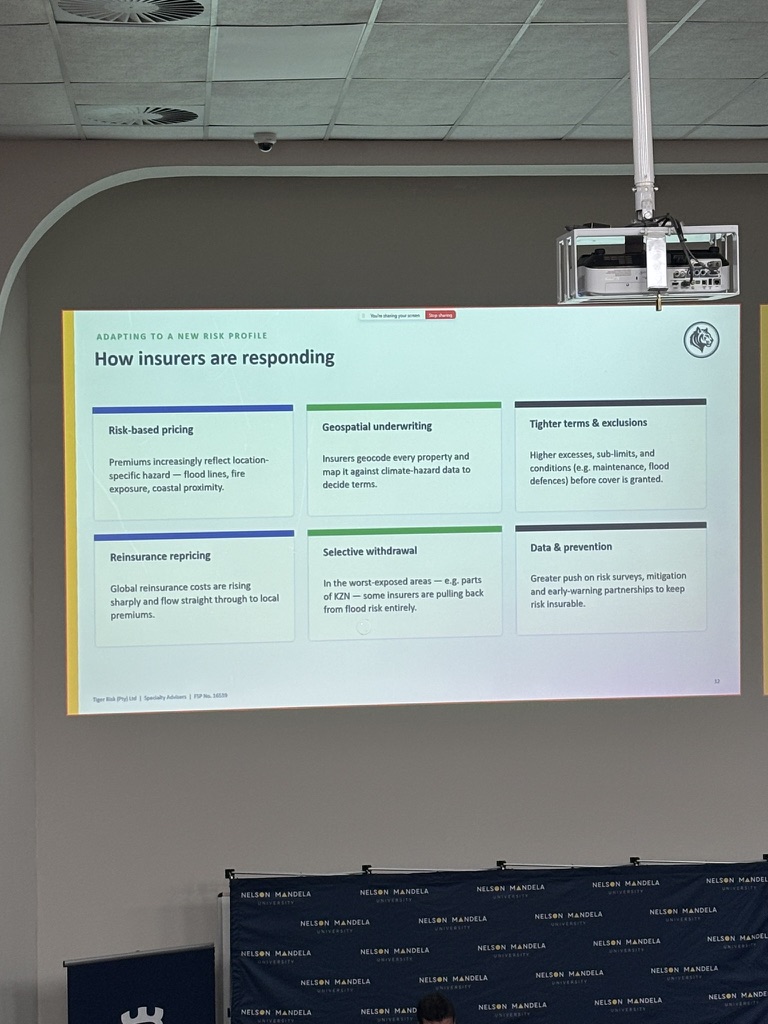
The presentation described a shift towards location-specific pricing and geospatial underwriting. Insurers increasingly combine property-level information with flood, fire, coastal and weather-hazard data. This means that two properties in the same town can receive very different terms depending on their exposure to floodplains, wildfire interfaces, unstable slopes, coastal erosion, drainage constraints or limited road access.
It also means municipal infrastructure matters to private insurance outcomes. Drainage, culverts, bridges, roads, power resilience, catchment management, firebreaks and emergency response capacity all influence the expected severity of future losses.
The Garden Route District’s climate adaptation plan already identifies floods, droughts, fires, coastal hazards, water security and infrastructure vulnerability as high-priority risks. It also notes that climate-related losses are expected to increase and that adaptation must be incorporated into planning and development decisions.
The protection gap leaves households, businesses and government exposed
Rabie’s presentation described a large protection gap: the share of economic loss not covered by insurance. This is especially consequential in South Africa, where many households and small businesses have little or no short-term insurance and may also be underinsured.
When a loss is uninsured, it does not disappear. It shifts to households, businesses, charitable networks, municipal disaster funds and provincial or national government. Recovery becomes slower and more uneven, particularly for small enterprises that cannot absorb prolonged disruption or finance rebuilding from reserves.
This is why insurance availability should be understood as a public-interest issue. It is connected to employment, property values, municipal finances, tourism, food production and the ability of communities to remain in place after repeated shocks.
Coastal risk is becoming an economic-planning issue
The presentation also highlighted sea-level rise, storm surge and coastal erosion. These are slower-moving than a wildfire or flash flood, but their effects accumulate. A higher sea level raises the baseline for storm surge and high-tide flooding, increasing repeated damage to coastal assets, estuaries, roads, bridges and tourism infrastructure.
The practical implication is that coastal planning cannot be treated only as an environmental matter. Setbacks, land-use decisions, estuary management, infrastructure design and, where necessary, relocation are increasingly decisions about long-term economic risk and insurability.

The above is of course of particular interest to Knysna as the town is already experiencing sunny day flooding.
Resilience and insurability are part of the same system
The presentation’s most important conclusion was that resilience and insurability reinforce each other. Investment in risk reduction can lower losses when an event occurs and help maintain access to insurance afterwards.
For businesses, this includes maintaining drainage and roofs, protecting stock and equipment, preparing for utility failures, keeping documentation current, reviewing sums insured and business-interruption cover, and testing continuity plans. For municipalities and the region, it includes maintaining critical infrastructure, reducing flood and fire exposure, protecting catchments and wetlands, improving early warning and emergency response, and ensuring future development does not deepen existing risk.
Insurance remains a vital safety net. But it works best when the underlying risk is being actively reduced. The Garden Route’s challenge is not only to recover from the latest event. It is to reduce the losses from the next one before they occur.
In our resilience workshops we often use this graphic to illustrate the point:
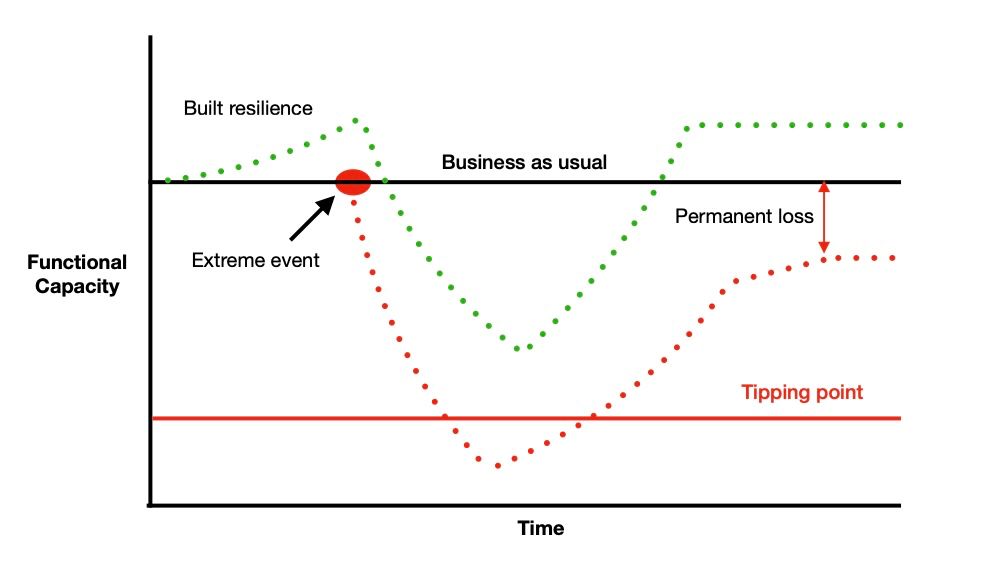
When resilience plans are in place and executed on, it results in what we call "built resilience" which when an extreme event strikes ensures that a community, business, family etc. is not taken below a tipping point from which full recovery is not possible and permanent loss is experienced.
Building resilience is now an immediate priority.